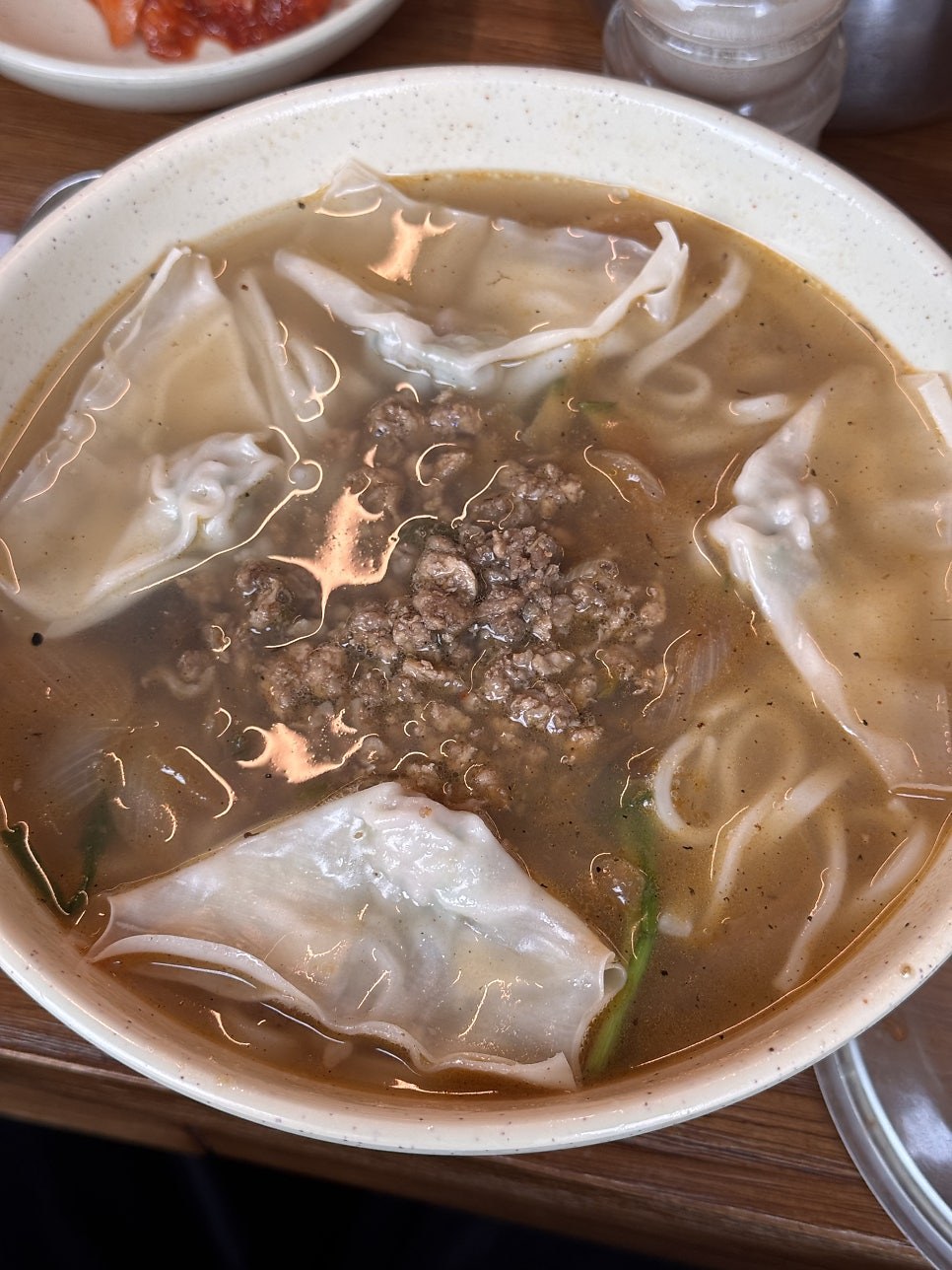
If you have one meal in Myeongdong and want something every Seoulite would approve of, Myeongdong Kyoja (명동교자) is the safe bet. This noodle house has been serving the same bowl of Kalguksu (Knife-Cut Noodle Soup) since 1966, and it has carried a Michelin Bib Gourmand plaque since 2017. Lines form outside almost every day, and a large share of the people in them are travelers.
There is one thing older guides will not tell you: in May 2026 the Myeongdong Kyoja main store moved. The famous original branch in the back alley closed, and the big building right outside Myeongdong Station Exit 8 became the new main store. Below is everything you need for the new location: how the queue works, the pay-first ordering system, the free noodle and rice rule, what each dish tastes like, and what to order for one, two or four people.

Myeongdong Kyoja new location: what changed in 2026
A notice at the door dates the change to 13 May 2026. On that day the old main store at 명동10길 29 stopped operating, and the former annex by the station (once called the “new building”) took over as the main store. The old site is now under construction. Many map apps and older travel pages still pin the alley address, so double-check before you walk there.
| Branch | Where | What to expect |
|---|---|---|
| Main store (current) | 서울 중구 퇴계로 129, about 30 m from Myeongdong Station Exit 8 | Multi-floor building, elevator, lots of seats, fast turnover |
| Branch No. 1 (1호점) | Inside the Myeongdong shopping alleys (명동10길) | The old-school alley feel, handy while shopping |
| Former main store | 명동10길 29 | Closed on 13 May 2026, under construction |
Both branches serve the same short menu. If you are with older parents, kids or a group, the main store is far more comfortable.
Quick facts
- Address (show this to a taxi driver): 서울 중구 퇴계로 129 명동교자 본점
- Subway: Line 4 Myeongdong Station, Exit 8. The sign is visible as soon as you come up the stairs.
- Hours: daily 10:30 a.m.–9:00 p.m., last order 8:30 p.m., no afternoon break
- Phone: +82-2-776-5348
- Reservations: not taken for regular diners; walk in and queue. Groups of 30 or more can book on weekdays after 2:30 p.m.
- Payment: you order and pay before you sit down
- Takeout: Mandu (Steamed Dumplings) only
- Parking: none on site; use a paid lot nearby or simply take the subway
How ordering works, step by step
The system looks intimidating from the sidewalk, but it runs like clockwork once you know the steps.
- Join the right line for your party size. The sign at the entrance says parties of 1–2 wait on the window side, parties of 3–4 on the street side, and groups of 5 or more should ask the staff.
- Pick your food while you wait. Payment comes first, so decide in line. With only four dishes, this takes seconds.
- Go to the floor you are assigned and pay there. Staff send you to the first, second or third floor, where you order and pay at the entrance of that floor.
- Find your table number. After paying you are given a table number, printed large on each table.
- Grab cutlery from the drawer. Spoons and chopsticks sit in a drawer under the tabletop. Garlic kimchi, chili powder, pepper and dumpling soy sauce are already on the table. The food often arrives before you finish setting up.


Myeongdong Kyoja menu and prices
Prices on the in-store menu board as of November 2026:
| Dish | Price | Notes |
|---|---|---|
| Kalguksu (Knife-Cut Noodle Soup) | ₩12,000 | The signature; counts toward free noodle refills and rice |
| Bibim-guksu (Spicy Mixed Noodles) | ₩12,000 | Green chlorella noodles in a sweet-spicy sauce |
| Mandu (Steamed Dumplings) | ₩13,000 | 10 per steamer; available to take away |
| Kongguksu (Chilled Soy Milk Noodles) | ₩13,000 | Summer only, April to October |
| Garlic kimchi to go | ₩2,000 per pack | One pack per box of takeaway dumplings |

A sign warns that dumplings and the summer soy milk noodles can sell out early, so if mandu are a must, do not leave it until the last hour.
The free refill rule: one noodle dish per person
One of the best things about Myeongdong Kyoja is the free extra noodles and rice, but the rules on the wall are specific:
- You get extra noodles only if you order one noodle dish (kalguksu or bibim-guksu) per person. Dumplings do not count as a noodle dish.
- Each noodle order comes with rice once.
- Dumpling orders get no extra noodles or rice.
- Leaving extra noodles, rice or kimchi uneaten adds a waste charge: ₩1,000 for rice, ₩1,000 for kimchi, ₩2,000 for noodles.
So two people sharing one kalguksu and one plate of dumplings will not get refills. Order noodles for everyone, treat the dumplings as an extra, and ask for small portions of refills that you will actually finish.

What each dish tastes like
Kalguksu (Knife-Cut Noodle Soup), ₩12,000
A wide bowl filled to the brim with a deep, savory chicken broth, topped with a mound of seasoned minced meat. Hidden underneath are soft noodles and a few small thin-skinned dumplings. The broth starts out clean, then lingers with a toasty, almost lightly smoked richness from the meat and onions. It has nothing in common with the clam-based kalguksu you find elsewhere in Korea.
The noodles are silky and slide down easily, and the staff will top up broth if you ask. One bowl is already generous; with a refill of noodles, most adults leave very full.


Mandu (Steamed Dumplings), ₩13,000
Ten dumplings come in a steamer basket. The wrappers are thin enough to see the filling, and the meat filling is dense and juicy, so bite carefully. A quick dip in the soy sauce on the table is all they need.
Since the kalguksu already contains dumplings, two people ordering two soups plus a plate of mandu will be stuffed. With three or more people, one shared plate is the sweet spot.

Bibim-guksu (Spicy Mixed Noodles), ₩12,000
These noodles are green because chlorella is worked into the dough. They are thick and chewy, so a bowl is filling. The sauce is sweet first and spicy second, with minced meat mixed in for extra savoriness and crisp cucumber on top. It is the perfect opposite of the hot, rich soup, which is why many pairs order one of each and swap halfway.

Garlic kimchi: the real reason people come back
The kimchi in the steel pot on your table is not ordinary napa cabbage kimchi. It is loaded with raw garlic, sharp and properly spicy. Start with a small piece, then use it to cut through the rich broth between slurps. Plenty of regulars say they return as much for this kimchi as for the noodles.
Fair warning: the garlic stays with you for a while, so go easy if you have a meeting afterwards.

Kongguksu (Chilled Soy Milk Noodles), ₩13,000
A summer-only dish served from April to October. Visiting in autumn or winter, you choose from the other three.
What to order
| Party | Order | Approx. total |
|---|---|---|
| Solo | 1 kalguksu (+ noodle or rice refill) | ₩12,000 |
| Two people | 1 kalguksu + 1 bibim-guksu (refills included) | ₩24,000 |
| Two dumpling lovers | 2 kalguksu + 1 mandu | ₩37,000 |
| Three or four | One noodle dish each + 1 mandu | ₩49,000–₩61,000 |
Eating alone here is completely normal; there are seats suited to solo diners, and plenty of people pop in for a single bowl.
Wait times and the best time to go
The line outside looks long, but with this many seats it moves fast. On a weekend afternoon the wait can be just three or four minutes, and around 1 p.m. on a Friday you may walk straight in. Weekend evenings are the busiest, when the first two floors fill up and newcomers are sent to the third.
- Quietest: right at opening (10:30–11:00) and mid-afternoon (2:00–4:00 p.m.)
- Busiest: weekday lunch hour, weekend lunch and dinner
- Last order is 8:30 p.m., so do not cut it too close at night
Getting there from Myeongdong Station
Take Line 4 to Myeongdong Station and leave through Exit 8. The restaurant is about 30 m away, so you will see the sign the moment you reach street level. If you would rather visit Branch No. 1, walk roughly 200 m into the alley beside the main store.
There is no parking. Myeongdong traffic is heavy and nearby lots are expensive, so the subway is the easy choice. For a taxi, show the driver: 서울 중구 퇴계로 129 명동교자 본점 (명동역 8번 출구 앞).
Pros and cons
- Pro: The new location is impossible to miss and the big dining rooms keep the line moving.
- Pro: Free extra noodles and rice make it great value for a hungry traveler.
- Pro: The chicken-broth kalguksu with garlic kimchi is a combination you will not find anywhere else.
- Con: Loud and fast-paced; this is a place to eat, not to linger.
- Con: Ordering soups plus dumplings for two is a lot of food for the money.
- Con: The kimchi is genuinely spicy for anyone sensitive to heat.
- Con: The old address still appears online and can send you to a closed door.
FAQ
Is the Myeongdong Kyoja main store different from Branch No. 1?
The menu is the same. The main store is bigger, has an elevator and suits families and groups, while Branch No. 1 keeps the old alley atmosphere. Branch No. 1 is sometimes closed even when the main store is open, so plan around the main store.
When do I pay?
Before you sit down. You order and pay at the entrance of your assigned floor, then go to your table.
Can I take kalguksu away?
No. Only dumplings can be taken away, and you can add one ₩2,000 pack of garlic kimchi per box. Kimchi is not sold on its own.
Where else should I eat nearby?
For another legendary bowl of soup in the same neighborhood, try Hadongkwan in Myeongdong for Gomtang (Korean Beef Soup). If you are in the mood for cold noodles, pair this with Woo Lae Oak in Euljiro for Pyongyang Naengmyeon (Cold Buckwheat Noodles).
Remember three things and you will eat like a regular: the new main store is at Myeongdong Station Exit 8, order one noodle dish per person, and take only a little garlic kimchi at first.
Leave a Reply