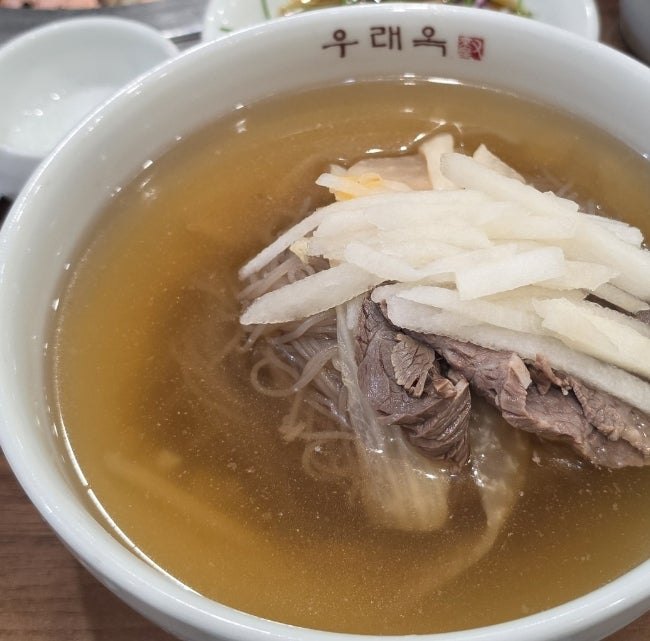
Short answer first: yes, Woo Lae Oak naengmyeon is worth the trip, as long as you know what you are walking into. Woo Lae Oak (우래옥) has been serving Pyongyang-style cold noodles in Euljiro, central Seoul, since 1946. A bowl costs ₩18,000, weekend lunch queues often pass 100 groups, and the broth tastes of beef rather than of vinegar and chili. If that sounds like your kind of meal, this guide covers everything else: how to get in, what each dish tastes like, how much to order, and when the line is shortest.

Quick facts
| Name | Woo Lae Oak main branch (우래옥 본점, sign reads 又來屋) |
| Address (show this to a taxi) | 서울 중구 창경궁로 62-29 |
| Nearest station | Euljiro 4-ga Station (Lines 2 and 5), Exit 4, about 75 m |
| Hours | Tue–Sun 11:30–21:00, last order 20:20; closed Mondays; no afternoon break |
| Phone | +82-2-2265-0151 |
| Signature dishes | Pyongyang naengmyeon ₩18,000; Hanwoo bulgogi ₩46,000 per 150 g |
| Queue | On-site Tabling kiosk only, opens 9:30 a.m.; no remote queuing |
Getting to Woo Lae Oak from Euljiro 4-ga Station
Take Seoul Subway Line 2 or Line 5 to Euljiro 4-ga Station and leave by Exit 4. The restaurant is roughly 75 meters away, a one- to two-minute walk. It sits a little back from the main road on a side lane, so first-timers sometimes miss the entrance. Look for a three-story building with a dark stone facade, a parking lot in front, and a red-carpeted staircase leading up to glass doors. If people are sitting in rows of chairs outside, you are in the right place. For walking directions, a Korean map app such as KakaoMap with 우래옥 본점 typed in works better than Google Maps.

Eighty years in one bowl: the story behind the name
The restaurant opened in 1946 near Euljiro 4-ga under the name Seobukgwan. Its founder had run a restaurant in Pyongyang before settling in Seoul. The Korean War shut it down, and when the family returned and reopened after the war, they renamed it Woo Lae Oak, written 又來屋 in Chinese characters, meaning “the house that came back.” The same family has run it for three generations, the current building went up in 1988, and the city named it a Seoul Future Heritage site in 2013. Plaques by the door show a MICHELIN Guide Bib Gourmand listing every year from 2022 to 2026.
Inside, it feels less like a hole-in-the-wall and more like an old-school formal dining hall. The ground floor holds a waiting area and tables; a red-carpeted staircase beneath a huge stained-glass window leads to the larger second floor, and there are private rooms as well. Tables are generously spaced, high chairs are available, and on any given day you will see three-generation families sharing grill tables next to solo diners slurping noodles.

How the queue and ordering work
This is where most visitors get tripped up, so here is the full sequence.
- Register in person. There is a Tabling kiosk at the entrance; enter a phone number for the call notification and your party size. Remote queuing through the app is not possible, and the kiosk opens for the day at 9:30 a.m.
- Wander, but not too far. The app and notifications show how many groups are ahead of you. Once you are within about 10 groups, stay close.
- Answer the call fast. When your number comes up you need to walk in within one minute, and you cannot push your turn back.
- Noodles or meat? Staff at the door ask whether you are eating only noodles or ordering grilled beef too, and seat you on the first or second floor accordingly.
- Pay. If you order only noodles or soup, you pay up front when you order. If your order includes meat, you pay at the end.
Two house rules worth knowing: solo diners can only be seated at shared tables, and the kitchen does not give extra broth or extra noodle portions. Every dish can be packed to go, takeaway orders skip the queue, and noodles or soups are usually ready in 10 to 20 minutes.
The Woo Lae Oak menu, with English names
Good news for visitors: the printed menu lists every dish in Korean, English, and Japanese, and all prices include VAT. Beef is exclusively domestic 1++ grade Hanwoo (Korean native cattle, cows only), and the rice, cabbage, chili flakes, onions, and garlic are Korean too. Noodle prices rose from ₩16,000 to ₩18,000 in April 2026.

| Dish | What it is | Price |
|---|---|---|
| Jeontong Pyongyang Naengmyeon (전통평양냉면) | Traditional Pyongyang-style cold buckwheat noodles in chilled beef broth | ₩18,000 |
| Pyongyang Bibim Naengmyeon (전통평양비빔냉면) | Buckwheat noodles with spicy sauce, no broth | ₩18,000 |
| Kimchimari Naengmyeon (김치말이냉면) | Cold buckwheat noodles in kimchi broth with rice | ₩18,000 |
| Onmyeon (온면) | Buckwheat noodles in hot beef broth | ₩18,000 |
| Large size (곱빼기), any noodle | About two portions of noodles | ₩28,000 |
| Hanwoo Galbitang (한우 갈비탕) | Beef short rib soup with rice; Tue, Thu, Sat only, limited | ₩25,000 |
| Hanwoo Yukgaejang (한우 육개장) | Spicy shredded beef soup with rice | ₩20,000 |
| Hanwoo Janggukbap (한우 장국밥) | Clear beef soup with rice | ₩20,000 |
| Bulgogi (불고기), 150 g | Marinated Hanwoo beef barbecue, cooked at the table | ₩46,000 |
| Bul-sari (불사리) | Buckwheat noodles added to the bulgogi broth | ₩10,000 |
| Galbi (갈비), 180 g | Grilled beef short ribs | ₩70,000 |
| Daegin Galbi (대긴갈비), 150 g | Grilled long beef ribs | ₩75,000 |
| Deungsim (등심), 150 g | Grilled sirloin | ₩78,000 |
| Anchangsal (안창살), 150 g | Grilled thin skirt | ₩85,000 |
| Hyeomitgui (혀밑구이), 160 g | Grilled beef tongue | ₩55,000 |
| Yukhoe (육회), 150 g | Korean beef tartare | ₩65,000 |
Grilled meat must be ordered for at least two portions, and for at least half the people at the table (beef tartare excepted). A table of four, for example, needs at least two portions. Drinks start at ₩6,000 for soju and ₩7,000 for local beer (Cass, Terra, Kelly); Sapporo is ₩8,000 and Yebisu ₩10,000. Soft drinks are ₩3,000, coffee ₩3,500, and ice cream ₩4,000.
What Woo Lae Oak naengmyeon and the other dishes taste like
Pyongyang Naengmyeon (Cold Buckwheat Noodles in Beef Broth)
The broth is made by simmering Hanwoo beef shank for hours and seasoning it with nothing more than salt and soy sauce. It pours clear and amber, and the first sip is distinctly beefy. Pyongyang naengmyeon has a reputation for tasting “bland,” but this version is on the savory, well-seasoned end of the style, which makes it one of the friendlier bowls for newcomers. Taste the broth before adding anything; vinegar and mustard are on the table if you want to change things up halfway through.
The noodles are thin buckwheat strands with a slightly rough surface and a bit more chew than at many other Pyongyang naengmyeon houses, with a nutty buckwheat aroma that builds as you eat. Toppings are pickled radish, pickled cabbage, and slices of Hanwoo beef that are thicker and more tender than you might expect from a noodle garnish.
Bibim Naengmyeon (Spicy Mixed Cold Noodles)
A heap of red sauce sits on top and looks fierce, but once mixed it is more savory than hot. The sauce coats the noodles without drowning the buckwheat flavor. It is a good second bowl to share alongside the broth version, or a safer choice for anyone unsure about cold soup.

Kimchimari Naengmyeon (Cold Noodles in Kimchi Broth with Rice)
Here the beef broth is blended with tangy kimchi juice, and both buckwheat noodles and rice are dropped in together. There is a gentle sesame-oil note, and enough beef fat floats on top that it is richer than a clear kimchi soup. Noodles and rice in the same cold bowl divides opinion, so share it before committing to a whole one.

Onmyeon (Warm Buckwheat Noodle Soup)
The same beef broth served hot, with buckwheat noodles, a few slices of beef, scallions, and sesame. It eats like a light beef noodle soup and is milder in seasoning than the cold version. On a freezing Seoul day, or for anyone who does not want cold food, it is the comfortable pick.
Yukgaejang, Janggukbap and Galbitang (Beef Soups with Rice)
The yukgaejang (spicy beef soup) is loaded with chunks of beef and fernbrake, and it is the classic backup order for anyone in your group who is not sold on cold noodles. The janggukbap is a clear beef-and-rice soup at the same price. The galbitang (beef short rib soup) is made only on Tuesdays, Thursdays, and Saturdays in limited quantities and can sell out early.
Bulgogi and Bul-sari (Table-Grilled Beef, Then Noodles in the Juices)
Bulgogi is the restaurant’s other headliner. Staff cook it for you on a perforated copper grill and pour bulgogi broth around the rim, so the beef half-grills, half-simmers. It comes out tender and sweet without being sugary, and the mushrooms soak up the juices nicely. When you are most of the way through, order bul-sari: a portion of buckwheat noodles dropped into the reduced broth. The sweet marinade clings to the noodles and makes them taste even nuttier. The portion is big, and the noodles break easily in the hot broth, so tongs work better than chopsticks.

What arrives before your food
As you sit down you get a cup of warm buckwheat cooking water, nutty and completely unseasoned. The only standard side dish with noodles is a cabbage geotjeori (fresh, lightly fermented kimchi) with a sweet, tangy dressing and a toasty sesame aroma. It pairs so well with the noodles that many tables ask for refills. Meat orders come with more side dishes, such as seasoned radish.

Portion sizes
A regular bowl fills an average adult comfortably. The large size holds two big bundles of noodles, close to two bowls, and since there are no free refills of broth or noodles, big eaters should order large from the start. If two people share two portions of bulgogi plus bul-sari, a single regular naengmyeon to split is plenty.
When to go to avoid the worst of the wait
Lunch is much busier than dinner. A few real data points: registering around 1 p.m. on a public holiday behind 108 groups meant about 90 minutes of waiting; a Saturday at 2 p.m. with 92 groups ahead showed an estimate of 90 minutes; and arriving at 10:30 a.m. on a weekend, an hour before opening, still meant a three-and-a-half-hour wait. Weekday evenings are far easier: about 30 minutes with 31 groups ahead at 7 p.m., and often walk-in seating after 8 p.m.
Because the dining room is huge and noodle tables turn over quickly, the number drops faster than you would expect. Register, then explore nearby Cheonggyecheon Stream, Gwangjang Market, or Bangsan Market while tracking your place. There is no break time, though on quiet afternoons the second floor sometimes closes and reopens at 5 p.m., so a weekday late afternoon is another good window.

Reservations, parking and other practicalities
Can you book a table?
Only if you are eating grilled meat. Groups of four or more who order one grilled portion per person can reserve by phone (+82-2-2265-0151): at least one week ahead for weekdays, at least two weeks ahead for weekends. Noodle-only and soup-only diners must queue. If you want limited cuts like anchangsal or daegin galbi, pre-order them when booking.
Parking
There is a private lot directly in front with valet service. The fee is ₩3,000 for up to three hours from April to September or up to two hours from October to March, then ₩1,000 per 10 minutes. Waiting time counts toward that limit. When the lot is full, staff may point you to the nearby Euljiro Twin Tower car park. With the station this close, the subway is the easier choice.
What to order, by group
- Solo: one Pyongyang naengmyeon (large if you are hungry). ₩18,000–28,000. Expect a shared table.
- Two, noodles only: one Pyongyang naengmyeon plus one bibim or kimchimari naengmyeon to compare. ₩36,000.
- Two, one skeptic: one Pyongyang naengmyeon plus one Hanwoo yukgaejang. ₩38,000.
- Two, the full experience: two portions of bulgogi, one bul-sari, one Pyongyang naengmyeon. ₩120,000.
- Family of four (book ahead): four portions of bulgogi, one bul-sari, two naengmyeon, two onmyeon or janggukbap. About ₩266,000–270,000.
Bulgogi first, cold noodles to finish, is the long-standing way to eat here. Wrapping a slice of bulgogi in a mouthful of noodles is also highly recommended.
The honest verdict
What we like
- Deep, savory Hanwoo broth that is approachable for first-timers
- Generous, tender beef slices on top of the noodles
- Bulgogi and bul-sari make it a full meal, not just a noodle stop
- Spacious, polished dining room that works well for families and older relatives
- Two minutes from the subway, no break time, on-site parking and valet
- Menu in English and Japanese
What to be ready for
- Prices: ₩18,000 per bowl and ₩46,000 and up per portion of beef
- Long weekend lunch waits and no remote queuing
- No extra broth or noodles, and solo diners share tables
- Some diners find the broth too savory or the noodles salty; purists who want a very light broth may prefer it elsewhere
- Only one side dish with noodle orders
Pair it with nearby stops
Cross Cheonggyecheon Stream from Woo Lae Oak and you reach Gwangjang Market, perfect for a second round of mung bean pancakes; see our guide to Gwangjang Market bindaetteok at Soonhee. For another historic Seoul soup house, read about Hadongkwan gomtang in Myeongdong. And if you are looking for a place to stay in Jongno, our pick is Woodam, a whole-house Airbnb in Bukchon.
Menu, prices and policies reflect 2026 and may change. Remember: closed Mondays, and galbitang only on Tuesdays, Thursdays and Saturdays.
Leave a Reply