It is a little after six in the evening at Exit 9 of Dongdaemun Station. Turn down one side street and the smell of simmering pots hits you, along with sign after sign reading “닭한마리” (Dakhanmari) on both sides of the lane. Oddly, though, the crowd is gathered in front of just one door. People hold small paper number tickets and keep their eyes on a display board outside. That door belongs to Jinokhwa Halmae Wonjo Dakhanmari (진옥화할매원조닭한마리).
If you search for Dongdaemun Dakhanmari, sooner or later you end up at this name. It has been in the same alley since 1978, and the old name, “(구)진할매원조” (formerly Jin Halmae Wonjo), is still printed in small letters under the sign. The menu is essentially one dish: Dakhanmari (Whole Chicken Hot Pot), a whole chicken simmered in clear broth. Eating that one pot well takes more know-how than you might expect. This guide walks a first-timer through it step by step, from getting a number ticket to the dipping-sauce ratio, when to add the rice cakes, and when to order the noodles.

Dongdaemun Dakhanmari: Why Everyone Heads to Jinokhwa Halmae
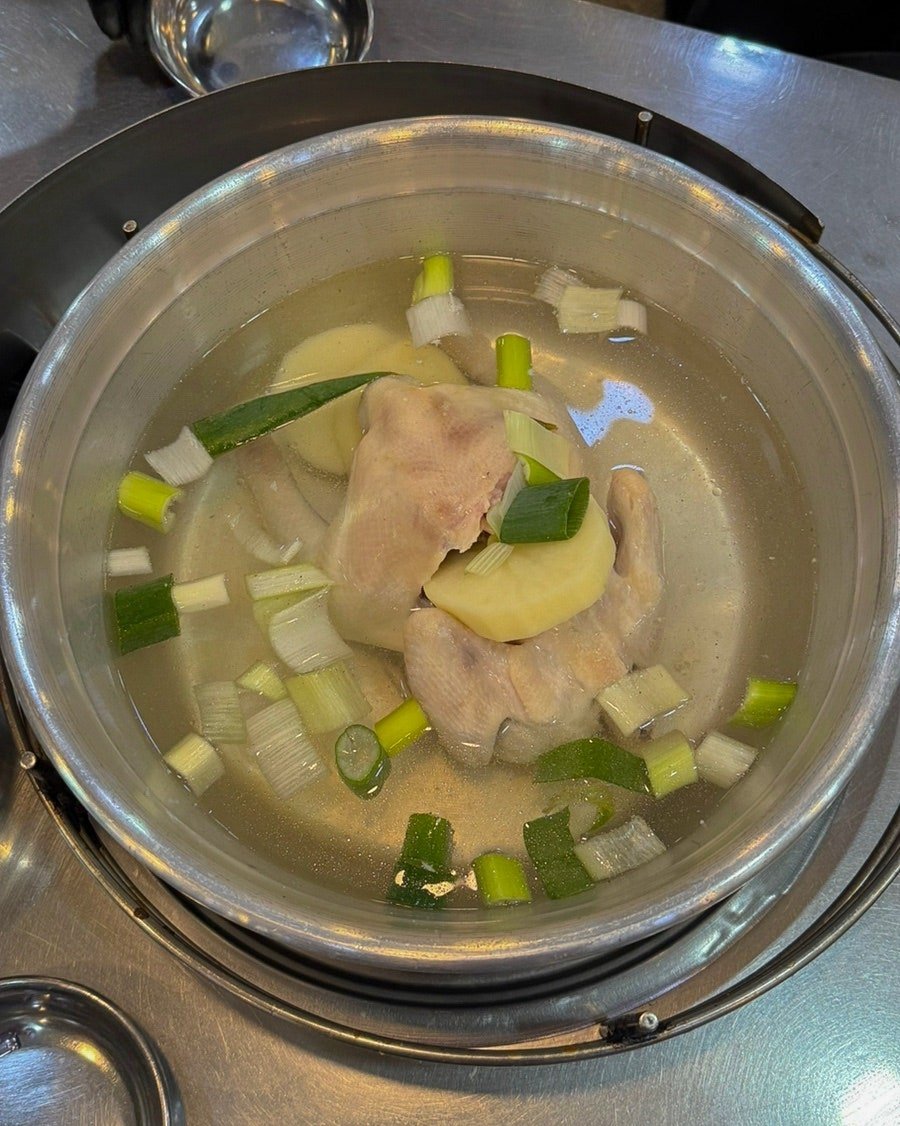
Dakhanmari literally means “one whole chicken.” It is a Seoul-style chicken dish in which a whole bird goes into a pot and simmers at the table. It is not served in an individual stone bowl like Samgyetang (Ginseng Chicken Soup). Instead, a large aluminum pot sits on a gas burner on your table and the whole group cooks and eats from it together, much like a hot pot. You fish out the chicken and dip it in sauce, then finish the remaining broth with rice cakes and Kalguksu (Knife-Cut Noodles), so one pot covers both the main course and the meal.
The lane between Jongno 5-ga and Dongdaemun Station, inside the food alley across from Dongdaemun Market, is lined with Dakhanmari restaurants, and locals simply call it “Dakhanmari Alley.” This one is busier than the rest for two reasons: its long history and its simple flavor. The broth, made with nothing more than chicken, green onion and potato, is so clear at first that it might seem mild, but it grows richer the longer it boils. The name is also well known among foreign travelers, so on an evening visit you will naturally hear Japanese and Chinese at the next table.

It All Starts with a Number Ticket
There is no app-based remote queue here. When you arrive, go into the ground floor of the main building first, tell a staff member how many people are in your group, and take a number ticket. You do not write your name on a list; you hold a paper ticket and wait. When it is your turn, your number appears on the display board outside. If you miss it, staff will often call the number out loud.
One thing confuses many first-timers: numbers are not always called in order. Groups are seated to match the size of the table that frees up, so a later number can go in first. If you are a pair and a group of four goes in ahead of you, do not panic; just keep watching the board. If you are five or more, tables will need to be joined or split, so mention it when you take your ticket.
Busy Times and Quieter Times
- Weekday lunch: plenty of customers, but there are so many seats that the wait is usually short or none.
- Weekdays 3–5 p.m.: the easiest window. You are likely to be sent straight to the annex.
- Weekdays 6–8 p.m.: the line never stops. Expect around 40 minutes.
- Weekend lunch: it starts filling up around noon, when the annex opens, and some days the wait runs from 40 minutes to over an hour.
The main building has three floors and there is a separate annex right next door, so the line moves faster than its length suggests. The annex opens at 12 noon, so in the morning only the main building is seating customers. If you would rather take your food to go, head to the annex for takeout.
Once You Sit Down, the Menu Is Decided
As soon as you are seated, a pot sized for your group arrives before anyone even asks for your order. All that is left is choosing your add-ons, called sari. Prices on the wall menu are as follows.
- Dakhanmari (Whole Chicken Hot Pot) ₩33,000 (Korean-raised chicken, per pot)
- Tteok sari (rice cake add-on) ₩2,000
- Pa sari (green onion add-on) ₩2,000
- Guksu sari (Kalguksu knife-cut noodle add-on) ₩2,000
- Gamja sari (potato add-on) ₩3,000
- Gonggibap (bowl of steamed rice) ₩1,000
- Drinks: Makgeolli (Korean rice wine) ₩4,000, soju or beer ₩5,000 each, Cheongha or Maehwasu ₩6,000 each, Baekseju or Sansachun ₩8,000 each, Bokbunja (Korean black raspberry wine) ₩12,000
- Soft drink: oolong tea ₩3,000

The menu also lists Dakdoritang (Spicy Braised Chicken, ₩30,000), but Dakhanmari is the reason to come. The basic pot already contains some green onion and potato, so the green onion and potato add-ons are optional. The rice cake add-on, on the other hand, is close to essential, and the noodle add-on can only be ordered once. The restaurant does not accept a second noodle order because it makes the broth cloudy, so decide how much you want for the finale when you place your first order.

While the Pot Heats Up: Make Your Dipping Sauce
Once the pot is on the flame, a staff member comes over and cuts the whole chicken into easy-to-eat pieces with scissors. Your job in the meantime is to mix your own dipping sauce. On the table you will find dadaegi (a red chili paste seasoning), soy sauce, vinegar, mustard, pepper and salt, and a dish of minced garlic arrives with the first pot. There is no single right answer, but this basic ratio is a popular one.
- Put 1–2 tablespoons of dadaegi in an empty bowl. Add a little more if you like heat.
- Pour in about 2 tablespoons of soy sauce, then 1 tablespoon each of vinegar and mustard.
- Add only half of the minced garlic to your sauce and stir the other half into the broth in the pot.
- Finally, mix in one or two spoonfuls of the simmering broth to soften the saltiness and get the right consistency.
The finished sauce is tangy and spicy rather than sweet. The nose-tingling kick of mustard cuts through the richness of the chicken fat, and the vinegar keeps you dipping again and again. Too much soy sauce makes it salty quickly, so start with less and adjust as you taste.

How to Eat One Pot in Four Rounds
Round One: Rice Cakes as Soon as They Float
The chicken needs time to cook through. What keeps hunger at bay in the meantime is the rice cake add-on. When the long wheat rice cakes bob up to the surface, scoop them out and dip them in your sauce right away. They are smooth outside and soft inside, with a chewiness different from the rice cakes in Tteokbokki (Spicy Rice Cakes). Once rice cake that has soaked up chicken broth meets tangy sauce, your impression of the place changes. Even people who do not usually care for rice cakes finish a plate in no time.

Round Two: Chicken, Piece by Piece
When the staff tell you it is ready, it is time to start fishing out the chicken. Here is one tip. Lean parts that dry out easily, like the breast, should come out as soon as they are cooked, before they boil too long, so they stay moist. Fattier parts with more skin, like the legs and wings, give more flavor to the broth the longer they simmer, and the meat becomes tender. The chicken is a good size, so each piece is filling. Dip it in your sauce, then follow with kimchi from the self-service corner, and you get clean, mild flavor and refreshing tang in turn.

Round Three: Broth That Time Builds
Your first spoonful of broth may taste milder than you expected. But as the chicken, green onion and potato boil for close to 40 minutes, the broth turns milky and the flavor deepens. Sprinkle in a little pepper at this point and it tastes like a rich Dakgomtang (Chicken Bone Soup). When white foam rises to the surface, skim it off with the ladle. If you want to enjoy the broth on its own, you can also order a bowl of rice (₩1,000) and stir it in.

Round Four: Finish with Kimchi Kalguksu
When the chicken is almost gone, add the noodles. Stir in plenty of kimchi from the self-service corner and some dadaegi, and the clear broth quickly turns red and spicy. The noodles are on the thick side with a satisfying chew, and the reduced chicken broth soaks right into them. They go soft fast, so serve yourself as soon as they are cooked. From the same pot you get a completely different dish: a hearty, spicy bowl of noodles after the clear chicken course.

How Big Is It, and How Many People per Pot?
One pot of Dakhanmari can be ordered for up to four people. In practice, though, it is just right for two adults with add-ons. Three people will need generous amounts of rice cakes and noodles to feel full, and four people will be far more comfortable with two pots.
- 2 people: Dakhanmari + rice cakes + about one serving of noodles → about ₩37,000
- 3 people: Dakhanmari + rice cakes + green onion + two servings of noodles → about ₩41,000
- 4 people: 2 pots of Dakhanmari + 2 rice cakes + noodles → about ₩72,000
Add-ons cost only ₩2,000–3,000, so two people can have rice cakes and noodles and still stay under ₩40,000. For a meal in the middle of downtown Seoul, that is quite reasonable.
The Main Building, the Annex and the Scene Inside
The main building is an old-school restaurant left as it was. From the ground floor to the third floor, stainless steel tables are packed close together, each with a gas burner and a big aluminum pot. Often the front doors are left wide open while people eat. The annex next door is a newer building and feels a bit cleaner, but the menu and the taste are the same. Wherever you are seated, there is no need to worry about it.

A few things are self-service. You fetch your own kimchi and water, and the kimchi refrigerator is near the stairs. The kimchi is cool and pleasantly sour, which goes well with the chicken. The broth splashes easily, so grab one of the aprons hanging next to the refrigerator. The staff move fast, cutting chicken and seating guests with practiced efficiency, but with so many customers it is not the place for attentive, personal service. Go expecting the lively bustle of a market eatery rather than a quiet dinner and you will enjoy it.
Walking from Dongdaemun Station
The subway is the easiest way to get there. Leave Dongdaemun Station (Lines 1 and 4) by Exit 9 and walk toward Jongno 5-ga; in about five minutes you reach the entrance of Dakhanmari Alley. Inside the alley, the main building with its old sign and the annex stand side by side. It is also within walking distance of Jongno 5-ga Station (Line 1). For a taxi or map app, the address is 서울 종로구 종로40가길 18 (18 Jong-ro 40ga-gil, Jongno-gu, Seoul), and the phone number is 02-2275-9666.
If You Are Driving
There is no restaurant parking lot, and the alley is too narrow to stop in. You will need a nearby paid lot. Seoul Jung-gu Community Center Parking (서울중구구민회관 부설주차장, 40 Eulji-ro 39-gil, Jung-gu), five minutes away on foot, costs around ₩3,600 per hour, one of the cheaper options nearby, while the roadside public parking along Cheonggyecheon Stream runs about ₩9,000 per hour. Hyundai City Outlet Dongdaemun and the Dongdaemun Market parking lot are also close. Rates can change, so check before you go.
The Honest Pros and Cons
The good: there is nothing to decide, the pot arrives as soon as you sit down, and staff cut the chicken for you, so even first-timers will find it easy. The chewy rice cakes and the kimchi noodle finale are what bring people back. Long hours, from 10:30 a.m. to 1 a.m. (last order 11:30 p.m.) with no break time, make it a good stop for a late lunch or a late-night meal. And for two people the bill stays under ₩40,000.
The not-so-good: waits at dinnertime and on weekends are hard to avoid, and with no remote queue you have to wait on site. It is cramped and noisy inside and can get hot in summer. The broth may taste plain at first, and chicken taken out too early or boiled too long can turn tough or dry. In the end, this is a place that rewards people who know how to wait. Be a little patient with the line and with the pot, and it pays off.
Before You Go
- Hours: daily 10:30 a.m.–1 a.m. (last order 11:30 p.m.); annex opens at 12 noon; no break time
- Waiting: tell staff your group size on the ground floor of the main building and take a number ticket; no remote queue
- Ordering tip: get rice cakes at the start; noodles can be ordered only once, so decide the amount in advance
- Self-service: kimchi, water, aprons
- Takeout: available at the annex
- Address: 서울 종로구 종로40가길 18 (about 5 minutes’ walk from Exit 9, Dongdaemun Station)
Prices and house rules can change, so it is a good idea to call ahead before you visit.
Keep Eating Around Jongno and Euljiro
Walk a short way west from Dakhanmari Alley along Jongno and you reach Gwangjang Market at Jongno 5-ga. If you still have room, sharing a mung bean pancake there makes a great second stop; see our guide to Gwangjang Market Bindaetteok at Soonhee’s. If you are craving a cool broth for lunch the next day, Woo Lae Oak naengmyeon in Euljiro at Euljiro 4-ga fits neatly into the same route.
Leave a Reply