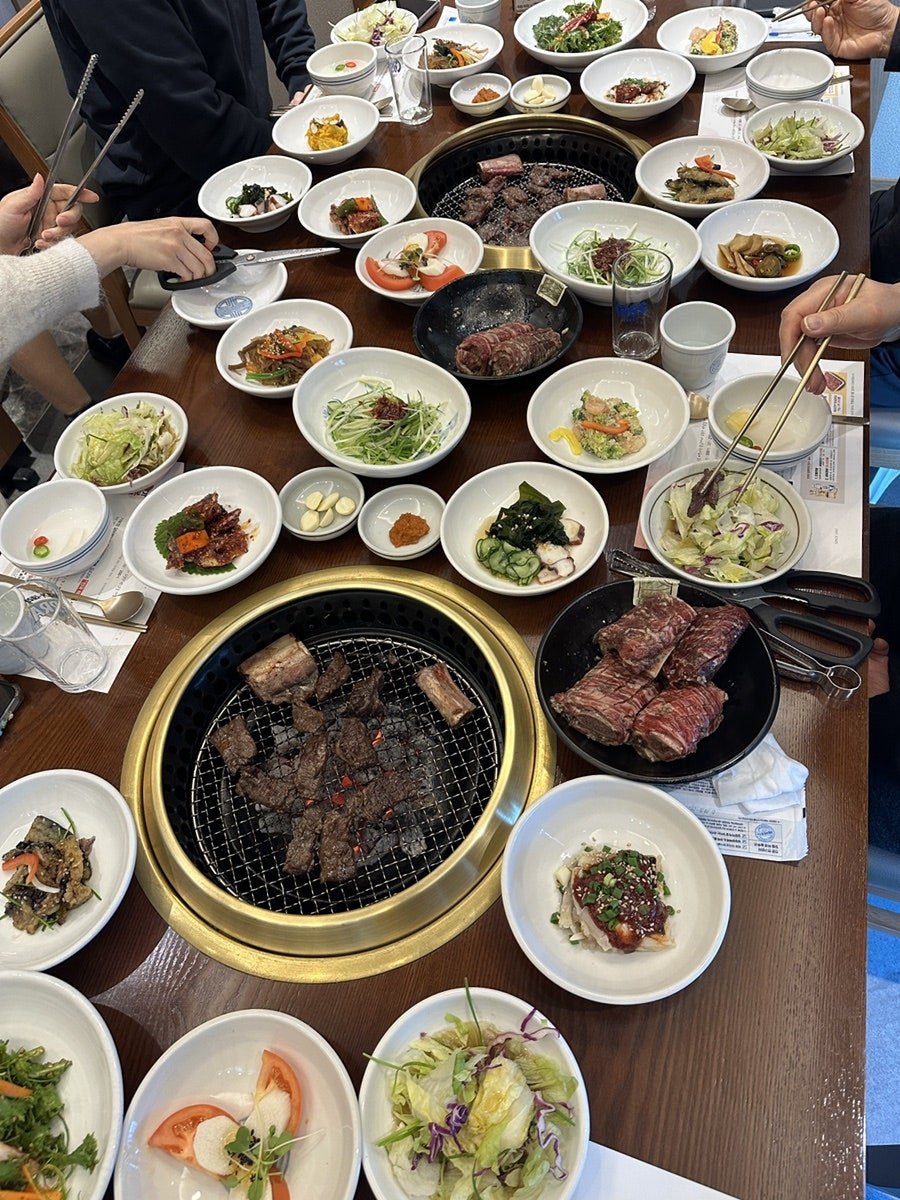
Tell anyone in Korea you are going to Suwon and the reply is almost always the same: “Go eat galbi.” Alongside Hwaseong Fortress and Hwaseong Haenggung Palace, Suwon galbi (beef short ribs) is the thing the city is known for, and when people look for the best Suwon galbi restaurant, one name comes up first: Gabojeong (가보정) on Jangdari-ro in Ingye-dong. Three buildings on one short street all carry the same sign, so arriving feels less like walking into a restaurant and more like entering a small galbi village.
Then you open the menu and the questions begin. One portion of hanwoo (Korean native beef) saeng-galbi costs 130,000 won, yet the same place sells a weekday lunch set in the 40,000-won range. Hanwoo and US beef, unmarinated and marinated ribs all come with different weights and prices. This guide walks you through exactly what a first-timer needs to know, in the order you will need it.

The Essentials at a Glance
- Address: 경기 수원시 팔달구 장다리로 282 (의성빌딩, 인계동) — Building 2 is at 장다리로 281, Building 3 at 장다리로 283
- Phone / reservations: 1600-3883, reservations by phone only (no online booking)
- Hours: Mon–Fri 11:30–21:30 / Sat and public holidays 11:00–22:00 / Sun 11:00–21:30
- Weekday lunch set: Mon–Fri from opening until 15:00 (not on weekends, public holidays or Labor Day)
- Getting there: about a 3-minute walk from the Dongsuwon Intersection bus stops; about 1.4 km from Suwon City Hall Station on the Suin-Bundang Line
- Parking: lots behind and under Building 2 plus a parking tower at Building 3, free for diners (register your car when you pay)
Why Gabojeong Is the Suwon Galbi Restaurant Everyone Mentions
Gabojeong opened in 1992 as a beef short rib specialist. It started small and now runs Buildings 1, 2 and 3 facing each other across Jangdari-ro. The table mats list the seat counts: 600 in Building 1, 550 in Building 2 and 250 in Building 3. That is bigger than most wedding halls, and on weekend lunchtimes parking staff direct cars from the very start of the street.
At the heart of the flavor is the marinade. The owner, Kim Oe-sun, is a designated Korean Food Master (Sikpum Myeongin No. 89) for garigui, the traditional grilled short rib, and the menu marks the hanwoo marinated ribs and marinated rib lunch set as made with “the Food Master’s special marinade.” The menu also states its beef policy: hanwoo is 1++ grade whenever possible, with 1+ used when supply is tight, while US beef is Prime grade, or the top 10 percent of Choice when Prime is hard to get.
Inside you will find hanok-style wooden lattices, a vast main hall and floor after floor of private rooms. Near the entrance there is a huge aquarium and a wine cellar, plus an Iron Man figure dressed in a KT Wiz baseball uniform that every waiting child stops to look at. There is even a bank ATM inside, which tells you a lot about the scale of the place.

Hanwoo or US Beef? Saeng-galbi or Yangnyeom-galbi?
The menu splits into four main paths. The table below shows the per-portion weight and price as printed on the menu (which also has English and Japanese). Every meat order comes with starter dishes and banchan (side dishes), and the staff grill the meat for you.
| Menu | Weight per portion | Price |
|---|---|---|
| Hanwoo Saeng-galbi (Unmarinated Korean Beef Short Ribs) | 250 g | 130,000 won |
| Hanwoo Yangnyeom-galbi (Marinated Korean Beef Short Ribs) | 270 g | 79,000 won |
| Hanwoo Chaekkeut Deungsim (Korean Beef Striploin) | 150 g | 69,000 won |
| Hanwoo Yukhoe (Korean Beef Tartare) | 180 g | 39,000 won |
| US Saeng-galbi (Unmarinated US Beef Short Ribs) | 450 g | 79,000 won |
| US Yangnyeom-galbi (Marinated US Beef Short Ribs) | 450 g | 71,000 won |

Hanwoo Saeng-galbi: The Priciest Bite, and the One You Remember
When the plate arrives, the deep pink meat is laced with fine marbling and everyone reaches for their phone. Seared quickly over charcoal and dipped lightly in salt, it fills your mouth with a nutty beef aroma and juice. It is a rich cut, so after a few pieces it can feel heavy; a dab of wasabi cleans up the finish. Wasabi and lettuce wraps may not be on the table by default, so just ask the staff. The 250 g portion disappears fast, and it is trimmed fairly thin along the grain, so if you expect a thick, chunky bite it may feel slightly light. It also sells out, so if you really want it, pre-order it when you reserve by phone.

Hanwoo Yangnyeom-galbi: Order This to Taste the Food Master’s Marinade
270 g for 79,000 won. The soy-based, sweet-and-savory marinade soaks right into the meat, and when it meets the charcoal the classic galbi sweetness jumps out. The seasoning is assertive, so on its own it can taste salty; it really shines with a bowl of white rice or doenjang-jjigae (soybean paste stew).
US Saeng-galbi and Yangnyeom-galbi: The Most Filling Choice
A US beef portion weighs 450 g, far heavier than hanwoo. That weight includes the bone, though, so there is less meat than the plate suggests. The unmarinated ribs come with thick bones and thickly cut meat for a satisfying chew, while the marinated version uses the same style of marinade as the hanwoo ribs, so if marinade is what you are after, the 71,000-won US yangnyeom-galbi is the better value. 270 g versus 450 g says it all.

Striploin and Yukhoe: Good Dishes to Slot in Between the Ribs
The hanwoo striploin (150 g, 69,000 won) is cut thick and takes a little longer to cook, but it is leaner and less rich than the saeng-galbi. The hanwoo yukhoe (Korean beef tartare, 180 g, 39,000 won) arrives on a bed of finely shredded garnish topped with an egg yolk, and the staff mix it at the table. It is perfect to eat while you wait for the ribs to grill.

The Weekday Lunch Set: The Smartest Way to Eat at Gabojeong
If budget matters, the answer is a weekday lunch. These set meals are sold only Monday to Friday from opening (11:30) until 3 p.m., and each comes with one rib portion, the standard side dishes, doenjang-jjigae and a bowl of rice. The rule is one set per person, and they are not available on weekends, public holidays or Labor Day (May 1).
| Lunch set | Meat weight | Price |
|---|---|---|
| Hanwoo Yangnyeom-galbi set (Marinated Korean Beef Short Ribs) | 135 g | 45,000 won |
| US Yangnyeom-galbi set (Marinated US Beef Short Ribs) | 225 g | 43,000 won |
| US Saeng-galbi set (Unmarinated US Beef Short Ribs) | 225 g | 47,000 won |
The sets are not a discount on the regular menu; they are a separate format with less meat plus a full rice table. The hanwoo set is only 135 g and can feel small, so if you want more meat, the 225 g US sets are the better pick. The number of side dishes is not very different from dinner, which is why the lunch sets feel like such good value.
A Table Where the Side Dishes Steal the Show
There is a reason people say Gabojeong is “more about the banchan than the meat.” Once you order, salad, refreshing dongchimi (radish water kimchi), garlic and ssamjang (dipping paste) arrive first, followed by japchae (glass noodles), fried eggplant, yangnyeom-gejang (spicy marinated raw crab), seasoned greens, seaweed salad, tomato with yam, sweet pumpkin and more until the table has no empty space. The seasoning is gentle and tidy, closer to a hanjeongsik (Korean course meal) restaurant than a typical barbecue house.

The clear favorite is the neulgeun-hobakjeon (aged pumpkin pancake). It is sweet and chewy and everyone asks for another plate, but it takes so long to cook that it cannot be refilled or ordered extra. Savor it while it lasts. The plump yangnyeom-gejang, on the other hand, can be refilled, so ask if you want more of that rice thief. Most other side dishes can be refilled too.

Rice, Noodles and How to Finish
Once you have had your fill of ribs, the classic finish here is rice and stew. The doenjang-jjigae (5,000 won) is simmered in an earthenware pot with beef bone stock and plenty of tofu and vegetables; it is deeply savory and balances the sweet-salty marinated ribs. Rice is 2,000 won, brown rice 3,000 won and nurungji-tang (scorched rice soup) 4,000 won.

The naengmyeon (Korean cold noodles) is made with house-made broth and noodles. Both mul-naengmyeon (cold noodles in broth) and bibim-naengmyeon (cold noodles with chili sauce) cost 12,000 won as a side with meat or 15,000 won as a full meal. The mul-naengmyeon is well seasoned even without vinegar or mustard, and the bibim-naengmyeon is sweet and clean. For two people, sharing one meal-size bowl works well. The hanwoo galbitang (beef short rib soup, 28,000 won) is the pick if you want a single bowl instead of grilled meat. After the meal you get sujeonggwa (cinnamon punch) and yakgwa (honey cookies) for dessert.
Reservations, Waiting and Parking, Step by Step
- Reserve by phone only (1600-3883): book weekend dinners and private rooms at least a week ahead and popular dates two to three weeks ahead; five days before is sometimes already too late. Same-day reservations are practically impossible.
- Deposit: 10,000 won per person (children included), deducted from the bill. You may not get a confirmation text after transferring, so call once more to check; a reminder text arrives the day before.
- Room time limit: private rooms are limited to two hours, so keep an eye on the clock if you plan to order a lot.
- Walk-ins: queue tickets are issued only at the kiosk in Building 2. There is no remote queueing; when your turn comes you are seated in whichever building has space. Staff call numbers at the entrance and they also show on a screen; miss yours and you have to take a new ticket, so stay close.
- Parking: follow the parking staff to the lot behind Building 2 or the Building 3 parking tower. You must register your car at the counter when paying for it to be free; parking beyond your meal time costs 3,000 won per 10 minutes. Show your receipt at the cafe on the first floor of Building 1 for 1,000 won off each coffee and an extra 1 hour 30 minutes of parking.
Waits vary hugely by day. On weekday lunchtimes you can usually walk straight in if you arrive just before opening; on Sunday lunchtime around 12 groups ahead of you is common, and because tables for six or more are few across all three buildings, larger groups sometimes wait over an hour. For groups, a reservation is all but essential.
Which Building Will You Sit In?
Building 1 is the main building, with private rooms on every floor, so family gatherings and formal meetings between families are usually booked here. Rooms have a wardrobe so your coats pick up less smoke, and the staff provide high chairs and children’s cutlery. There is a cafe on the first floor of Building 1, handy for waiting before your booking. Building 2 is where you take a queue ticket and has a large hall, and Building 3 doubles as the parking tower and a banquet hall. Seating mixes raised floor areas where you take off your shoes and regular tables where you keep them on, so bring socks if you are coming with kids.

Break times differ by building too. Building 1 takes an afternoon break and resumes seating at 5 p.m., while Building 2 runs without a break. On weekends and public holidays, 15:30–16:30 is the staff meal time; you can still eat, but waits get longer and service slows. If you arrive in the mid-afternoon, expect to be sent to Building 2.
Getting There from Suwon City Hall Station and Dongsuwon Intersection
From the Shinhan Bank at Dongsuwon Intersection (동수원사거리), turn right onto Jangdari-ro and walk about 50 m; the buildings face each other on both sides of the street. The nearest bus stops are “수원고용복지플러스센터·동수원사거리·삼성생명” and “KBS수원센터·KB손해보험,” both within 200 m.
By subway, the closest station is Suwon City Hall Station on the Suin-Bundang Line, but it is about 1.4 km away, roughly an 18-minute walk, so a taxi is quicker. From Suwon Station or Hwaseong Haenggung, a taxi is the easiest option; just tell the driver “Ingye-dong Gabojeong” (인계동 가보정) and most will know it. On a day trip from Seoul, an easy plan is to explore Hwaseong Fortress in the morning and arrive in time for the weekday lunch set.
What to Order by Group Size, with Estimated Totals
- Two people, weekday lunch: two US yangnyeom-galbi sets = 86,000 won. For more meat, make one of them the US saeng-galbi set (47,000 won).
- Two people, dinner: one hanwoo saeng-galbi + one US yangnyeom-galbi + doenjang-jjigae + two rice = about 218,000 won. A good way to compare unmarinated and marinated ribs in one go.
- Family of four: two hanwoo saeng-galbi + two US yangnyeom-galbi + one hanwoo yukhoe + two doenjang-jjigae + four rice = about 459,000 won. With kids, a meal-size mul-naengmyeon (15,000 won) works well instead of the yukhoe.
- Eating order: lighter unmarinated meat first, marinated ribs later. If you order both hanwoo and US beef, eat the US beef first and finish with hanwoo to really notice the difference.
Drinks include traditional Korean liquor, whisky and both red and white wine. If you bring your own bottle, corkage is 20,000 won per 750 ml bottle, and outside food is not allowed.
Pros and Cons
| Pros | Cons |
|---|---|
| Staff grill the meat from start to finish, so you can focus on the conversation | Hanwoo saeng-galbi is 130,000 won per portion, so dinner gets expensive |
| Side dishes on par with a Korean course restaurant, mostly refillable | The most popular pumpkin pancake cannot be refilled |
| Private rooms, high chairs and a big parking tower make family meals easy | Weekend reservations are competitive and walk-ins can wait over an hour |
| A full galbi meal in the 40,000-won range with the weekday lunch set | Marinated ribs are on the salty side; the naengmyeon is just decent |
| Menu in English and Japanese, easy for foreign visitors to order | Busy service can feel a little rushed |
In short, Gabojeong is the “expensive but never a letdown” Suwon galbi restaurant. For a parent’s birthday or a family gathering where the table and service matter, book dinner; if you are a traveler who just wants to experience Suwon galbi, go for the weekday lunch set. If you are heading back to Seoul afterwards and want more places to eat, see our best restaurants in Seoul by neighborhood guide.
Menu prices and opening hours are as of November 2026 and may change on holidays or special days, so call ahead before you go.
Leave a Reply