Finish a slow loop around the stone walls of Gyeonggijeon Shrine and you will be hungry right on cue. A few steps away on Eojin-gil street, a long tiled roof carries a big blue sign: “HAN KOOK JIB”. This is Hankook Jib (한국집), a family restaurant that has served Jeonju Bibimbap (Mixed Rice with Vegetables) since 1952, now run by the third generation, and the name that comes up first whenever people look for a Jeonju bibimbap restaurant near Jeonju Hanok Village.
The menu looks simple, but the first decision is real: the classic brass-bowl bibimbap, the raw-beef version, or the sizzling stone pot? So this guide flips the usual order. The practical details (address, hours, parking) are collected at the very end, and we start with what actually lands on your table.
In three lines
1. First visit? Order Yukhoe Bibimbap (17,000 won). Not into raw beef? Jeonju Bibimbap (15,000 won).
2. Weekend lunch (12:00–13:00) often means a 30–40 minute wait. Go before 11:00 or after 14:00.
3. Private parking lot right next door, free for 1 hour when you eat here.

What Is Hankook Jib, the Classic Jeonju Bibimbap Restaurant?
Hankook Jib opened in 1952 and has stayed a bibimbap specialist ever since. A “Centennial Store” plaque from the Korean government hangs at the entrance, and the waiting area is lined with old black-and-white photos and a glass cabinet of the brass bowls and tableware the restaurant once used, which makes the wait more interesting. It is the default stop for travelers who feel they cannot leave Jeonju without eating bibimbap, and you will hear plenty of other languages at the tables.
The building is a converted hanok (traditional Korean house). In the main hall, exposed wooden rafters sit above rows of four-person tables, and larger groups simply push tables together. An annex sits next to the main building with a small garden of pine trees and stepping stones in between, so window seats look out on greenery. It is calmer than you would expect for a restaurant in the middle of a tourist area, which makes it an easy choice for a meal with parents.


Three Bowls of Jeonju Bibimbap: What Is the Difference?
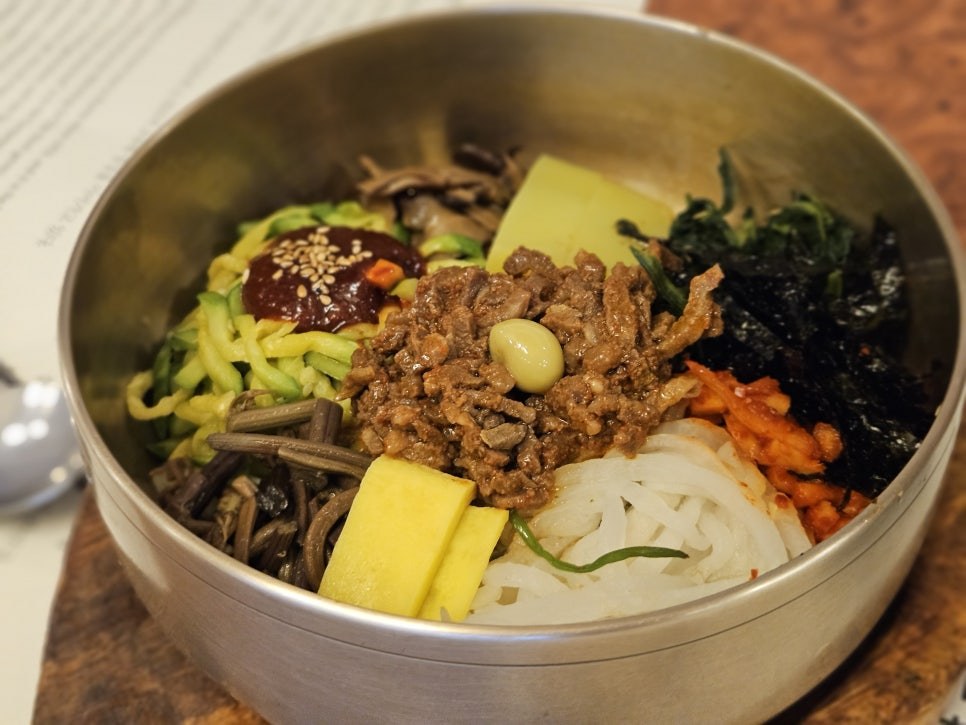
There are four bibimbap options. Jeonju Bibimbap and Dolsot Bibimbap are 15,000 won each; Yukhoe Bibimbap and Nakji Bibimbap are 17,000 won each. The menu explains that since opening, the restaurant has never added a raw egg yolk, so its fishy taste does not mix with the vegetables. A few yellow ginkgo nuts sit in the center instead. The menu also states that every bowl uses house-made gochujang (Korean red chili paste) brewed from 100% Korean ingredients.
Jeonju Bibimbap (Mixed Rice with Vegetables), 15,000 won: The House Classic
Rice goes into a pre-heated brass bowl (yugi), then the toppings are arranged by color: minced Korean beef cooked in seasoning, yellow hwangpomuk (mung bean jelly tinted with gardenia), fern brake, mushrooms, bean sprouts, seasoned radish, seaweed and strips of egg crepe. A spoonful of gochujang sits in the middle. It leans mild and slightly sweet rather than spicy, so kids and people who avoid heat can enjoy it. The seasoning is gentle enough that each ingredient still tastes like itself, and that is the signature of this kitchen.
A warning about the bowl: brass holds heat very well. Your rice stays warm to the last bite, but do not grab the rim or let your lips touch it. Mix with chopsticks in light, lifting motions instead of pressing with a spoon, so the rice does not turn mushy.

Yukhoe Bibimbap (Mixed Rice with Raw Beef Tartare), 17,000 won: Order This First
For 2,000 won more, the cooked beef is swapped for a generous mound of seasoned raw Korean beef, finished with ginkgo nuts and pine nuts. The beef tastes fresh and clean with no gamey smell, which is why this is the most-ordered bowl in the house. The cool beef against the warm rice is half the fun. Some diners do wish there were more beef in the bowl, so if you want a real plate of yukhoe, look at the sets below.

Dolsot Bibimbap (Hot Stone Pot Mixed Rice), 15,000 won: For Crispy Rice Lovers
The toppings match the classic bowl (cooked beef and vegetables), but it arrives in a heated stone pot that keeps sizzling until the end. The rice that sticks to the bottom turns golden and nutty, which makes it especially good on a cold day or for dinner. If the brass bowl is “tradition”, the stone pot is “comfort”. Two people torn between them can simply order one of each and share.

Nakji Bibimbap (Spicy Octopus Mixed Rice), 17,000 won: For Spice Fans
A whole small octopus stir-fried in a spicy sauce goes on top. It is a completely different mood from the mild classic, and children who are not used to spice will be reaching for water, so save this one for heat lovers.
Side Dishes and Sets to Share
If you are two or more, it would be a shame to leave with only bibimbap. Prices below are from the menu.
- Yukjeon (Pan-Fried Beef Slices in Egg Batter) 25,000 won: thin slices of beef dipped in egg and pan-fried, served with a pile of seasoned chives on top. Thin enough to stay tender.
- Hanwoo Yukhoe (Korean Beef Tartare), large 40,000 won: dressed with minced garlic, pine nuts and sesame oil.
- Hanwoo Dolpan Bulgogi (Korean Beef Bulgogi on a Stone Plate) 28,000 won
- Haemul Pajeon (Seafood Scallion Pancake) 15,000 won: loaded with squid, generous for the price.
- Hwangpomuk-hoe (Seasoned Yellow Mung Bean Jelly) 15,000 won: a Jeonju specialty.
- Galbitang (Beef Short Rib Soup) 18,000 won (Australian beef), Yukgaejang (Spicy Beef and Vegetable Soup) 12,000 won (Korean beef), Doenjang Jjigae (Soybean Paste Stew) 10,000 won, Kongnamul Gukbap (Bean Sprout Rice Soup) 9,000 won
- Moju (Warm-Spiced Makgeolli Drink) 3,000 won per glass / 25,000 won per bottle; makgeolli 4,000 won; soju or beer 5,000 won; soft drinks 2,000 won
- Hankook Jib Sikhye (Sweet Rice Drink) 4,000 won per bottle (17,500 won for five)

Sets give each person a bowl of Jeonju Bibimbap plus one shared dish. Note that the bibimbap in a set is fixed as Jeonju Bibimbap and cannot be changed to the raw-beef or stone-pot version.
- Hanwoo Set (medium yukhoe 120 g + medium yukjeon + Jeonju Bibimbap): 2 people 70,000 won / 3 people 84,000 won / 4 people 98,000 won
- Yukhoe Set (large yukhoe 200 g + Jeonju Bibimbap): 2 people 66,000 won / 3 people 80,000 won / 4 people 95,000 won
- Yukjeon Set (large yukjeon, 8 pieces + Jeonju Bibimbap): 2 people 52,000 won / 3 people 66,000 won / 4 people 80,000 won
- Dolpan Bulgogi Set (stone-plate bulgogi + Jeonju Bibimbap): 2 people 54,000 won / 3 people 68,000 won / 4 people 81,000 won
- Hankook Jib Course (Jeongsik) (Jeonju Bibimbap + yukhoe + hwangpomuk + stone-plate bulgogi): 40,000 won per person, minimum 2 people. The bibimbap in the course is a smaller portion than the regular bowl.
Quick math for two: two bowls of Jeonju Bibimbap (30,000 won) plus a yukjeon (25,000 won) comes to 55,000 won, while the Yukjeon Set for two is 52,000 won. A notice offering a free bottle of sikhye with a large yukjeon (while stock lasts) has been posted at times, so it is worth asking when you order.

Banchan (Side Dishes) and Portions
Banchan arrive first: acorn jelly with soy dressing, two or three seasoned vegetables, spicy marinated crab, kimchi, kkakdugi (cubed radish kimchi) and pickled green chilies, plus a clear bean sprout soup. Almost nothing repeats what is already in your bibimbap, so they make a good back-and-forth with each spoonful. The acorn jelly and the cool, light soup pair especially well. Wet towels and warm tea are set at each seat, and families get a child seat and kid-size fork and spoon on request.
One bowl fills an adult comfortably. The bowl is packed, and once mixed it looks bigger than it did at first. For no leftovers: two people order two bowls plus one dish; three people take one set plus an extra bowl.

Waiting Times: When to Go
- Busiest: weekend lunch, 12:00–13:00. On weekends a line starts forming around 11:30, and 30–40 minute waits are common at the peak. Even a Friday lunch can mean 40 minutes.
- Quietest: right after opening at 9:50 until 11:00, and after 14:00. In the late afternoon the staff sometimes close half the hall because it is so quiet.
- How to queue: register with the QR code at the entrance, or write your name and party size on the waiting list. There is an indoor waiting area with wooden benches.
- Watch out: names are called inside only once or twice, so people waiting outside sometimes miss their turn. Pop back in now and then to check.
- Turnover: the hall is large and the staff are quick, so even a long line moves faster than it looks.

Parking and How to Get There
Parking: a gated lot sits directly to the left of the building. Diners park free for 1 hour, but you must register your car when you pay. Without registration or beyond 1 hour, the posted rates apply (2,000 won for the first 30 minutes, then 1,000 won per 10 minutes, 50,000 won max per day). There is also an EV charger. If the lot is full on a weekend, use one of the Jeonju Hanok Village public parking lots.
By public transport: from Jeonju Station (KTX and regular trains), take a city bus toward Jeonju Hanok Village, get off at the “Jeondong Cathedral (Hanok Village)” stop and walk toward Gyeonggijeon Shrine. If you are staying inside the Hanok Village, it is an easy stroll past Gyeonggijeon.
What to Order, by Group
- Solo: one Yukhoe Bibimbap and a bottle of sikhye. Not into raw beef? Dolsot Bibimbap.
- Two people: one Yukhoe Bibimbap + one Dolsot Bibimbap, plus yukjeon or seafood pancake. If you both want the classic bowl, the Yukjeon Set for two (52,000 won) is the better deal.
- Three or more with parents: the Hanwoo Set for three (84,000 won) plus a galbitang or doenjang jjigae, and a glass of moju each for a very Jeonju table.
- With kids: the mild Jeonju Bibimbap or galbitang. Skip the octopus bowl; it is too spicy for most children.
Honest Pros and Cons
What we liked
- Mild, house-made gochujang and light seasoning let every ingredient stand out. Even people who usually do not care for bibimbap finish the bowl.
- The hanok building and pine garden make it feel like a real Jeonju meal, not just a tourist stop.
- Parking next door with 1 hour free, child seats and a roomy waiting area make it easy for families.
- Leftover banchan are scraped into one bowl and discarded right at the table, which is reassuring.
What could be better
- 15,000 won for a bowl of bibimbap is a tourist-area price.
- It is a textbook, well-made bibimbap rather than a mind-blowing one. Go in with very high expectations and it may feel simply solid.
- Long weekend-lunch waits, and orders have occasionally been missed at the busiest times. Double-check your order once.
- The bibimbap in sets is fixed to Jeonju Bibimbap; no swapping for raw beef or stone pot.
Hankook Jib: Essential Info
- Address (for maps and taxis): 전북특별자치도 전주시 완산구 어진길 119 (119 Eojin-gil, Wansan-gu, Jeonju), next to Gyeonggijeon Shrine
- Hours: daily 9:50–20:50, last order 20:10. There is no fixed break time or regular closing day, but the restaurant may pause between lunch and dinner when needed, so call ahead for a late-afternoon visit or during major holidays (Seollal, Chuseok).
- Phone: 0507-1317-2286
- Reservations: no online booking; walk in and join the waiting list. Groups should call ahead.
- Takeout: available (container 1,000 won)
- Parking: private lot, free for 1 hour with a meal (register your car)
- Other: no pets; child seats available
After a bowl of bibimbap, the Hanok Village alleys are made for slow walking. If you are staying the night, take a look at Narn Hanok, a private garden hanok stay in Jeonju, about a 5-minute walk from the Hanok Village. Gyeonggijeon in the morning, bibimbap at Hankook Jib for lunch, a night in a garden hanok: that is the classic Jeonju trip.
Leave a Reply