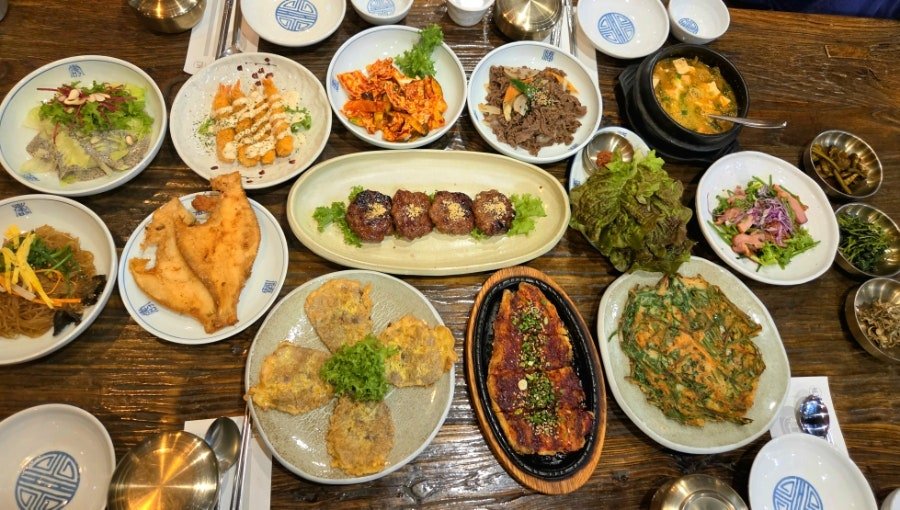
Three set meals, three Seoul neighborhood names, one menu board: Namchon, Seochon, Bukchon. That is the first decision you face at Chon (촌), one of the names that comes up again and again when people look for Insadong restaurants serving a proper Korean spread. This guide is built around that decision, because the price gap between the sets is real and so is the difference on the table.
Short answer first. For two first-timers, the middle Seochon set is the safest pick. If you are hosting parents, business guests or friends visiting Korea for the first time, the top Bukchon set earns its price with sheer variety. The details are below.

Chon, an Insadong Restaurant in a Traditional Hanok
Chon sits on Insadong 14-gil, a side alley off Insadong’s main culture street in Jongno, central Seoul. The building keeps the bones of an old hanok (traditional Korean house): look up and you will see the exposed wooden rafters, and out back there are earthenware sauce jars lined up the old way. The restaurant advertises a 25-year history, so it has been feeding this alley since long before Insadong became the tourist magnet it is today.
It is bigger than it looks from outside, with roughly 250 seats across the main hall and private rooms. That makes it a go-to for family gatherings, group dinners and formal meetings between families. Even so, it never feels like a banquet hall. Dark wood tables, clay jars, ceramics and wooden props break the space into cozy corners.

Step inside and a little stone fountain with trickling water greets you, set among green plants and an old stone mortar. Plenty of guests stop here for photos before or after the meal. Chon is also noticeably popular with international visitors. On holidays, foreign tour groups can arrive all at once, and solo travelers sitting down to a full spread are a common sight. There is an English menu posted by the entrance, which makes ordering easier.

The Three Hanjeongsik Sets Compared
Hanjeongsik means a Korean full-course set meal: many small dishes served together around rice and a stew. At Chon the sets require a minimum of two people. Prices are per person, and the lists below reflect what actually arrives at the table. A few side dishes may change with the season.
| Set | Price per person | What comes on the table |
|---|---|---|
| Namchon | 25,000 won | Soy-marinated pork bulgogi, grilled flounder, ureong muchim (spicy sweet-and-sour river snail salad), japchae (stir-fried glass noodles), green salad with perilla dressing, doenjang jjigae (soybean paste stew), seasonal sides |
| Seochon | 35,000 won | Pork bulgogi, grilled flounder, fried shrimp, smoked duck salad, black sesame salad, spicy whelk salad, japchae, savory pancake, lettuce wraps, doenjang jjigae, 5 small sides (about 15 dishes) |
| Bukchon | 45,000 won | Hanwoo (Korean beef) bulgogi, tteokgalbi (grilled short rib patties), kodari-gui (grilled half-dried pollock), grilled flounder, yukjeon (pan-fried beef in egg batter), buchujeon (garlic chive pancake), fried shrimp, ureong muchim, japchae, smoked duck salad, black sesame salad, namul (seasoned vegetables), lettuce wraps, doenjang jjigae or cheonggukjang |
Namchon Set (25,000 won): A Lighter Spread
The entry-level set centers on pork bulgogi in a soy-based marinade, joined by golden grilled flounder, tangy and spicy river snail salad, japchae and a salad. Soybean paste stew and multigrain rice come with it, which is plenty for lunch. If the point of the meal is conversation and the hanok atmosphere rather than a feast, this set does the job.

Seochon Set (35,000 won): The Popular Middle Option
Add 10,000 won and you get fried shrimp, smoked duck salad, black sesame salad, spicy whelk salad and a savory pancake on top of the Namchon lineup, roughly fifteen dishes in total. The hot fried and pan-fried items give the meal a nice rhythm between the cold sides. For two people visiting for the first time, this is the best balance of price and variety.
Bukchon Set (45,000 won): When You Are Hosting
The top set upgrades the meat. Pork bulgogi gives way to Hanwoo beef bulgogi, and thick tteokgalbi and yukjeon join the table. You get two fish, flounder and kodari, and two kinds of jeon (Korean pancakes). For the stew you choose between doenjang jjigae and cheonggukjang. Dishes arrive one after another, and more than once you will catch yourself thinking, “wait, there is more?” Four people on this set pay 180,000 won, not small money, but for a meal with elders or guests it feels worth it.

Dish by Dish: What It Tastes Like
Meat: Pork Bulgogi, Hanwoo Bulgogi and Tteokgalbi
Bulgogi (marinated grilled meat) here is salty-sweet from the soy marinade, with chewy pork that makes you reach for rice. The seasoning is gentle, so it pairs well with everything else on the table. The Hanwoo bulgogi in the Bukchon set comes with lettuce, so wrap a piece with a spoonful of rice and eat it in one bite.
The standout meat dish is Tteokgalbi (Grilled Short Rib Patties). Instead of being pressed thin, the patties are shaped thick and grilled, so they have a satisfying chew. Tteokgalbi is also on the menu as a stand-alone plate, so you can order more if one portion is not enough.

Fish: Grilled Flounder and Kodari-gui
Grilled flounder appears in every set: golden on the outside, mild and flaky inside, a white fish many people rarely cook at home. Only the Bukchon set includes Kodari-gui (Grilled Half-Dried Pollock), brushed with sauce and served on a sizzling iron plate. Chewy flesh, a sweet glaze and a generous scatter of scallions and sesame make it a crowd-pleaser.

Salads and Muchim: The Snail Salad Steals the Show
Among all the plates, the one chopsticks keep returning to is Ureong Muchim (Spicy Sweet-and-Sour River Snail Salad). Chewy snails tossed in a tangy, spicy dressing wake up your palate, and a bite between the richer pancakes and fried food resets everything. The spicy whelk salad in the Seochon set plays a similar role.
There are two salads: greens with a nutty perilla or black sesame dressing, and smoked duck salad with garlic chives, onion and honey mustard. They make a light opening before the meat and fish.

Pancakes, Fried Shrimp and Japchae
Eat the pancake and the fried shrimp the moment they land. The shrimp is fried crisp and comes with a sweet sauce, and the Bukchon set’s yukjeon is thin beef dipped in egg batter and pan-fried, doubling the jeon plate alongside the chive pancake. Japchae (Stir-Fried Glass Noodles) is well seasoned with plenty of mushrooms and vegetables, though some may find it ordinary. Chon’s strengths are in the other plates.
Stew: Doenjang Jjigae or Cheonggukjang?
Doenjang Jjigae (Soybean Paste Stew) here is loaded with napa cabbage, light and not salty, somewhere between a soup and a stew. On the Bukchon set, consider Cheonggukjang (Fast-Fermented Soybean Stew) instead: big cubes of tofu in a deep, nutty broth, a good pick if you want to taste Korea’s fermented food culture properly. The multigrain rice has just the right stickiness for piling on stew and side dishes.

Eating Solo, or Coming for a Drink
The full sets need two people, but solo diners are covered. Chon offers single-portion set meals that you can order at lunch and dinner alike. They come with the standard sides: seasoned greens, bean sprouts, kimchi, sweet black beans, stir-fried fish cake, japchae, soybean paste stew and lettuce. Basic side dishes can be refilled.
| Menu | Price |
|---|---|
| Pork bulgogi set meal (Korean pork) | 18,000 won |
| Hanwoo beef bulgogi set meal | 20,000 won |
| Grilled kodari set meal | 20,000 won |
| Grilled mackerel set meal (for 2) | 40,000 won |
| Seafood chive pancake / seafood kimchi pancake | 25,000 won each |
| Haemul pajeon (seafood scallion pancake) | 28,000 won |
| Dongtaejeon (pan-fried pollock) | 30,000 won |
| Dotorimuk muchim (acorn jelly salad) | 28,000 won |
| Dubu kimchi (tofu with stir-fried kimchi) | 30,000 won |
| Eomuktang (fish cake soup) | 35,000 won |
| Kodari-gui (as a dish) | 35,000 won |
| Tteokgalbi (as a dish) | 40,000 won |
| Gotaek Chapssal Saengju (glutinous rice wine) | 12,000 won |
If you drink, try the Gotaek Chapssal Saengju, an unpasteurized rice wine brewed with glutinous rice. At 12% ABV it is stronger than regular makgeolli (Korean rice wine), yet it goes down clean with a gentle rice sweetness that suits Korean side dishes better than sugary makgeolli. Makgeolli, soju and beer are also available.

Practical Info Before You Go
- Hours: daily 11:30 a.m. to 9:00 p.m.
- Break time: 3:00 to 5:00 p.m.
- Last order: 8:00 p.m. Arrive before 8.
- Reservations: by phone at +82-2-720-4888. Book ahead for weekends, holidays and groups; tables are set before you arrive.
- Seating: standard tables seat four, and there are no two-seat tables. Private rooms have you take off your shoes and step up, then sit on chairs; they are not fully soundproof.
- Parking: none on site. Use nearby paid or public lots, or better, take the subway.
- Also: groups welcome, takeout, Wi-Fi.
Many small eateries around Insadong close early, so finding dinner here can be surprisingly hard. Chon stays open until 9, which makes it an easy dinner stop after a day around Insadong and Bukchon. Arrive at opening and you will have room to choose your seat; by the height of lunch the hall fills up fast.
Who It Suits, and What Could Be Better
Chon works well when you want to show a first-time visitor many Korean dishes in one sitting, when you need a calm, polished room for a family celebration or a meeting between families, or when you simply want to eat inside a hanok. The seasoning is gentle, so it also suits older diners.
The downsides are clear too. No parking, no two-seat tables, and private rooms where you sit with your shoes off may not be comfortable for long, and conversation can carry to the next room. A few plates, like the japchae, are ordinary. If you expect inventive modern Korean cuisine, look elsewhere. If you want home-style Korean food laid out neatly and generously, you will be happy here.
How to Get There from Anguk Station Exit 6
- Take Seoul Subway Line 3 to Anguk Station and leave by Exit 6.
- Walk toward Insadong and enter the main Insadong culture street.
- Near Ssamziegil, turn into the Insadong 14-gil alley and look for the hanok with a large “촌” sign. It is about 200 m from the exit, roughly a 3-minute walk.
Address for taxis and map apps: 서울 종로구 인사동14길 19 (19 Insadong 14-gil, Jongno-gu, Seoul). You can also walk up Insadong-gil from Jongno 3-ga Station.
Pair It With a Walk Around Insadong
After the meal, browse the craft shops at Ssamziegil right nearby, or finish with tea at one of Insadong’s galleries and traditional tea houses. Cross over past Anguk Station and Bukchon Hanok Village and Changdeokgung Palace are within walking distance. For a dinner visit, a natural order is palace and hanok village by day, hanjeongsik as the last stop.
Walk a little further toward Jongno and market food awaits. For crispy mung bean pancakes at your next meal, see Gwangjang Market Bindaetteok: Soonhee’s, and for places to eat across other Seoul neighborhoods, open our Seoul restaurants guide by neighborhood.
Bottom Line: Seochon If Unsure, Bukchon to Impress
Among Insadong restaurants, Chon is a low-risk choice for a real Korean set meal. Watching plates fill the table under hanok rafters fits the neighborhood perfectly. Light: Namchon. Safe: Seochon. Hosting: Bukchon. Alone: a single set meal with a bottle of rice wine. Remember the break time and last order, and the table takes care of the rest.
Leave a Reply