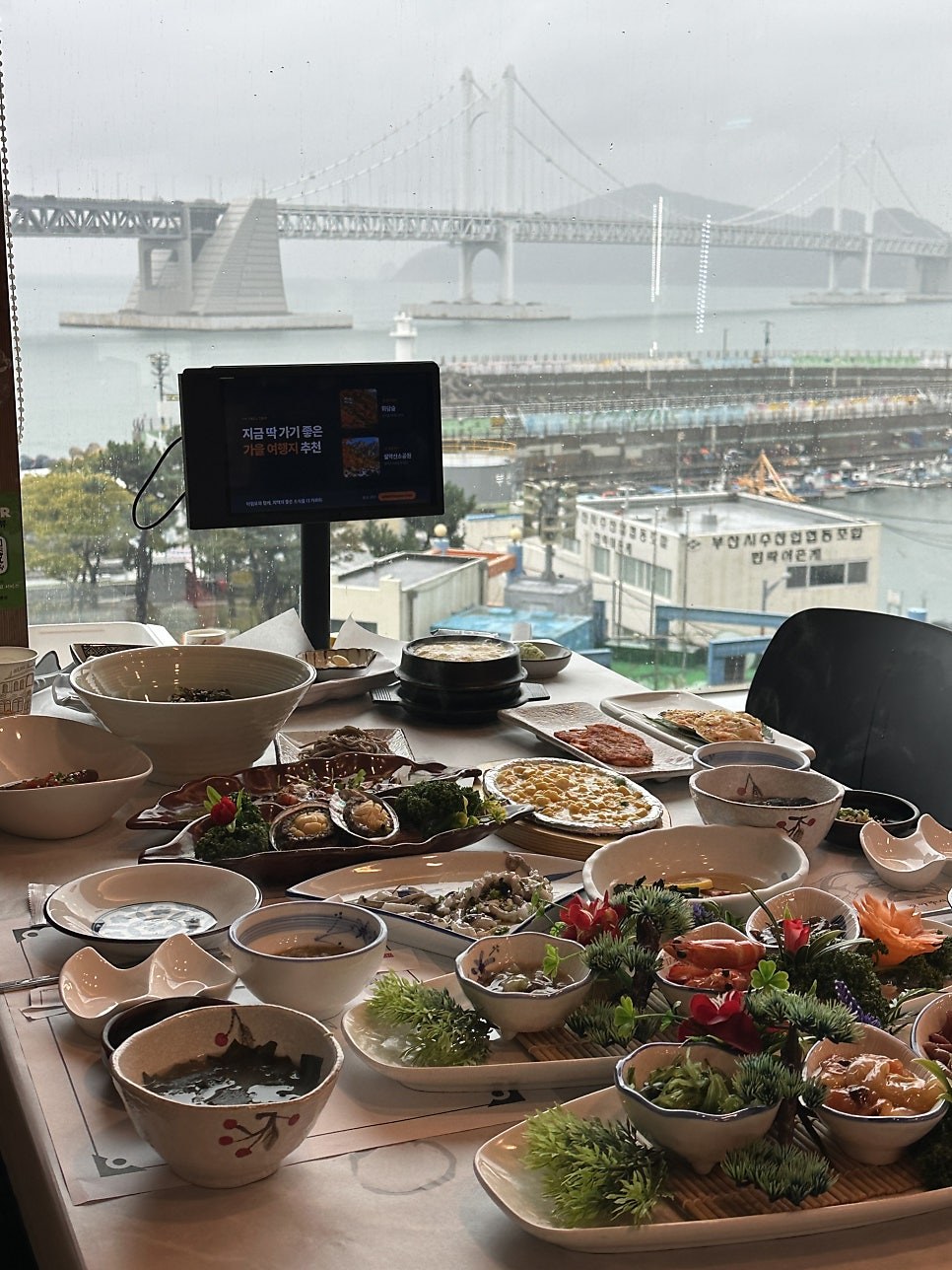
Gwangan Bridge stretches across the window, and the table fills up so fast that the staff have to shuffle plates to make room. On the 6th floor of a building facing Millak Waterfront Park in Millak-dong, Suyeong-gu, Geumrang Hoetjip Gwangalli Main Branch (금랑횟집 광안리본점) is the Gwangalli seafood restaurant to pick when you want two things at once: a proper sea view and a serious plate of hoe (Korean sashimi). You do not order one platter and wait. You order a per-person “hansang” (full-table set course), and more than ten dishes arrive in waves, from porridge at the start to spicy fish stew at the end, so first-timers barely need to study the menu.
This guide walks through the order in which the most popular course arrives, what separates the four set courses, how to get a window seat, and how to get there by bus, taxi or car.

Why Geumrang Stands Out Among Gwangalli Seafood Restaurants
Walk along Gwangalli Beach and raw fish restaurant signs never seem to end. Keep going past the eastern end of the beach into Millak-dong and you reach the Millak Raw Fish Town and Millak Waterfront Park. Geumrang takes up the entire 6th floor of the Marine Rich building (마린리치) right across from the park. Because it sits high up, the window seats give you a wide, uninterrupted view of the sea and the bridge, and even on a cloudy day the view feels open.
As you walk in, one wall is packed with framed autographs of celebrities, Blue Ribbon stickers and a 2022 “Taste of Busan” certificate. The restaurant has been in the same spot for many years, so locals book it for family dinners and formal meetings between families, and the floor has partitioned booths, small private rooms and a large group room. Near the kitchen there is a live fish tank visible from the dining area, and the fish inside are big enough that most people stop for a look before sitting down.

Four Set Courses: What Is the Difference?
The heart of the menu is the per-person “hansang” set course. Here is how the recommended menu board on the wall breaks down. Prices are per person, and you order one set for each diner.
| Course | Price per person | Sashimi | Highlights |
|---|---|---|---|
| Geumrang Hansang (금랑한상) | ₩80,000 | Premium market-price fish, grilled live rockfish | Steamed abalone, grilled Patagonian toothfish (mero) steak, gonowata; 2 refills of a small sashimi plate |
| Subyeon Hansang (수변한상) – best seller | ₩60,000 | Premium assorted sashimi | Steamed abalone, mero steak, gonowata, sannakji tangtangi (chopped live octopus), soy-marinated shrimp; 1 refill |
| Gwangan Hansang (광안한상) | ₩50,000 | Farmed + premium assorted sashimi | Chopped live octopus, soy-marinated shrimp, grilled fish; 1 refill |
| Bada Hansang (바다한상) | ₩40,000 | Assorted farmed-fish sashimi | Available only for groups of 10 or more |
All four courses share a common base: assorted seafood, miyeok-guk (seaweed soup), a seasonal dish, butter-grilled scallops, sushi, fritters, corn cheese and albap (fish roe rice in a hot stone bowl). To finish, you choose maeuntang (spicy fish stew) or jiri (mild clear fish soup). In the end the difference comes down to the grade of fish, whether the “step-up” dishes such as steamed abalone, mero steak and gonowata are included, and how many sashimi refills you get. Since the Bada Hansang needs a group of ten or more, a couple or a small group of travelers will choose between the Gwangan, Subyeon and Geumrang courses.
If a Full Course Feels Like Too Much: Lunch Special and Single Dishes
At lunch there is a ₩28,000 lunch special per person: 12 pieces of sashimi, hoedeopbap (raw fish rice bowl), octopus with vinegar dressing, sea squirt, steamed egg, a seasoned salad, spicy fish stew and side dishes. For a lighter meal there is hoedeopbap for ₩18,000 and seafood-abalone mulhoe (cold raw fish soup) for ₩22,000; order either for two or more people and spicy fish stew comes with it. If you just want sashimi, the assorted sashimi platter is sold by size, from small at ₩100,000 to the special platter at ₩250,000.

How the Subyeon Hansang Arrives, Start to Finish
The course most tables order is the Subyeon Hansang, labeled “best menu” on the board. For two people it comes to ₩120,000, for three ₩180,000. Dishes do not all land at once; they arrive in several waves, so knowing the order helps you pace yourself.
- Abalone porridge and assorted seafood – Warm jeonbok-juk (abalone rice porridge) to start, followed by a plate of seasonal seafood such as abalone, sea squirt and sea cucumber.
- Mulhoe and cold dishes – Cold raw fish soup with buckwheat noodles wakes up your appetite, followed by octopus with vinegar dressing, chopped live octopus, salmon salad and soy-marinated shrimp.
- Warm side dishes – Bite-size kimchi pancakes, silky steamed egg, sizzling corn cheese and butter-grilled scallops.
- Main sashimi platter and gonowata – Thick-cut assorted sashimi arrives with garnish, along with gonowata (fermented sea cucumber innards) sauce, laver sheets and sushi rice.
- Grilled, braised and fried – Mero steak, braised flounder and fried corn fill the table once more.
- Albap and spicy fish stew (or mild soup) – Fish roe rice in a stone bowl and a hearty maeuntang to finish.

The Main Platter: Sashimi You Can Really Bite Into
The sashimi is not sliced paper-thin and fanned out; it is cut thick so you feel the texture. The fish depends on what came in that day, so the line-up changes with the season, and on some days red sea bream takes the center spot. Flowers and greens decorate the plate, which makes it easy to photograph. With the Subyeon and Gwangan courses you can ask for one more small plate of sashimi after finishing, but so many dishes come before it that plenty of tables leave without ever using the refill. If sashimi is your priority, just taste the earlier dishes and save room.

The Signature Move: How to Eat Gonowata
The one combination you should try here is gonowata. It is fermented sea cucumber innards, salty with a deep, briny ocean flavor. Each person gets a small dish of it, and there is even a sign on the wall explaining how to eat it. Take a laver sheet (one per person), add a little vinegared sushi rice, dip a piece of sashimi generously in the gonowata, lay it on top with a slice of pickled ginger, and eat it in one bite. The laver and rice soften the saltiness, so even first-timers find it easier than expected.
Side Dishes You Keep Reaching For Even When Full
These are not filler dishes. The corn cheese stretches in long strings while it is hot, and the steamed egg comes in an earthenware pot, soft and wobbly. The fried corn is crisp and works as a palate cleanser between bites of sashimi, while the mero flakes apart in rich, buttery pieces. The braised flounder soaks up a sweet soy glaze that makes you want rice.

The Finish: Albap and Maeuntang
The last round is albap topped with seaweed flakes and flying fish roe in a hot stone bowl, plus maeuntang made from fish bones. The broth is spicy and rich, it deepens the longer it simmers, and there is plenty of meat left on the bones, so it is hard to put the spoon down even when you are full. If you prefer a non-spicy broth, switch to jiri.

How Big Are the Portions?
Short answer: even adults leave food on the table. Two people sharing the ₩60,000-per-person Subyeon Hansang fill every inch of the table, and after a lunch there you may skip dinner. Groups of three ordering three Subyeon sets often leave without using the sashimi refill. You might wonder if you can order fewer sets than people, but the hansang courses are priced per person, so the standard is one set per diner. If you are traveling with children, high chairs are available, and there are plenty of kid-friendly dishes like steamed egg, corn cheese, fried corn and albap.
Window Seats and Waiting: How to Plan
What makes or breaks the experience here is your seat. On the same floor, a window seat and an inner booth feel very different. If you want Gwangan Bridge straight ahead, ask for a window seat when you book. Reservations can be made by phone, through online booking or via the CatchTable app.
Even on weekday lunches, group gatherings and family bookings can fill the room, and on weekends, public holidays and dinner peak hours there is a wait. If you walk in without a booking, write your name on the waiting list at the entrance. Last order is fairly early at 9:05 pm, so for dinner aim to arrive around 8 pm at the latest to enjoy the course without rushing.

Getting There: Easier by Bus or Taxi Than by Subway
Geumrang is at the point where you walk from the eastern end of Gwangalli Beach past Millak Raw Fish Town to the front of Millak Waterfront Park. The subway is an awkward distance away, so on public transport the easiest option is to take a bus to the Millak Waterfront Park stop (민락수변공원 정류장), about a 3-minute walk away. If you are staying near the beach, you can make it part of a seaside walk toward Millak-dong; with luggage or in the rain, a taxi is better.
There are other businesses on the 1st and 2nd floors and lots of signs on the outside wall, so it can be a little confusing at first. Look for the building name “Marine Rich (마린리치)”, find Geumrang on the 6th floor in the entrance directory and take the elevator. The whole 6th floor is the restaurant. Separate men’s and women’s restrooms are inside, next to the fish tank.
Address for maps and taxis: 부산 수영구 광안해변로344번길 17-5 마린리치 6층 (17-5 Gwanganhaebyeon-ro 344beon-gil, Suyeong-gu, Busan, 6F Marine Rich).

Coming by Car
Park at the Waterfront Park public parking lot right across the street (or the Waterfront Children’s Park public lot), and the restaurant validates 2 hours of parking. The course runs long, so two hours can pass quickly; keep an eye on the time if you plan to linger.

Who It Suits, and Who It May Not
A Great Fit If
- You want to have raw fish “properly” once on your Busan trip but cannot decide which of the many places to walk into
- You are planning a family meal with parents or a group dinner that needs a private room or booth
- You want to try warm cooked dishes as well as sashimi
- Eating with a view of Gwangan Bridge is itself part of your itinerary
Possible Drawbacks
- Around ₩60,000 per person may feel steep – the lunch special, hoedeopbap or mulhoe are good alternatives.
- Light eaters – because you order per person, leftovers are common.
- Without a window seat the view loses much of its charm, so request one when booking.
- Not a late-night second stop – last order is 9:05 pm.
Good to Know Before You Go
| Item | Details |
|---|---|
| Name | Geumrang Hoetjip Gwangalli Main Branch (금랑횟집 광안리본점) |
| Address | 부산 수영구 광안해변로344번길 17-5 마린리치 6층 (Millak-dong 110-42) |
| Hours | Daily 11:30 am–10:30 pm, last order 9:05 pm, open year-round |
| Phone | +82-507-1400-5209 |
| Reservations | Phone, online booking, CatchTable |
| Parking | 2 hours validated at the Waterfront Park public parking lot |
| Public transport | About 3 minutes on foot from the Millak Waterfront Park bus stop |
| Seating | Ocean-view window seats, booths, small private rooms, group room |
| Other | Takeout available (takeout discount), paid corkage, high chairs |
Hours and prices can change, so if you want a window seat or are coming as a large group, it is worth calling ahead before you set off.
More for Your Gwangalli Trip
Looking for somewhere to stay nearby? See Gwangalli Airbnb: Orot Gwangan, a private house with an indoor jacuzzi in a quiet residential area near Gwangan Station. If you want another Busan meal built around soup, our guide to Obok Dwaeji Gukbap in Haeundae, a 24-hour pork and rice soup spot near Haeundae Station, is a good next read.
Leave a Reply